

REVAMPING OR REPOWERING?
Solar farms degrade over time as panels and other components age, losing as much as 20% of their capacity over 20 years. To counter this, asset owners are increasingly replacing equipment through two approaches: revamping and repowering.
Revamping replaces or upgrades equipment while maintaining the site’s original total installed capacity. Repowering goes further by increasing the installed capacity or introducing additional technologies, such as batteries.
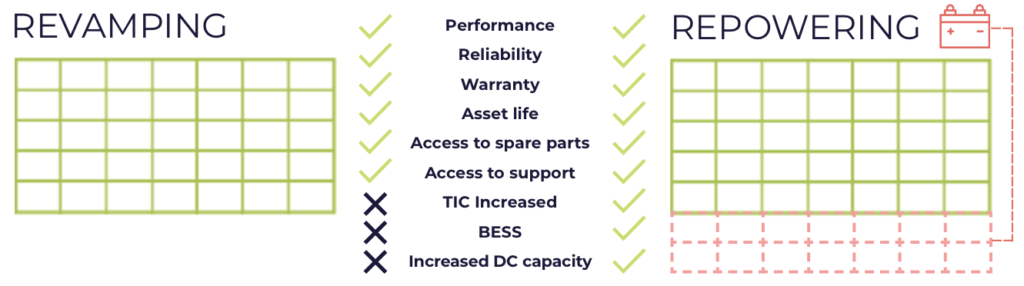
Repowering offers the chance to add real site value but as we all know, there is basically no new grid capacity available: a typical new connection date in Scotland is 2036. Revamping is therefore the available option,
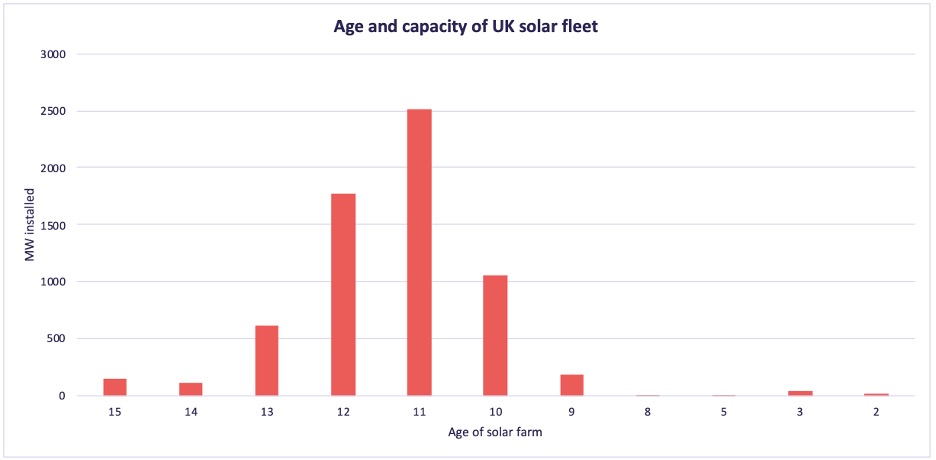
This is increasingly relevant as the solar fleet is aging. Europe saw an explosion of solar capacity installed between 2008 and 2015, when policy support peaked (figure 2). Supported by the Renewables Obligation and Feed-in-Tarriff (FiT), the UK went from having near zero PV to 6GW of capacity by the end of 2014.
We are seeing the impact of installations which were rushed to meet the original FiT deadlines. Shortcomings in design, storm resilience and grid connection arrangements are creating additional costs for asset owners. Whilst these aging projects may have reasonable operational life remaining, owners increasingly face decisions about replacing components, extending project lifetimes and improving returns.
THE COMING WAVE
In its July 2025 white paper, Repowering: The Investment Case for Renewing Renewables, Stafford Capital Partners estimated that more than 150 GW of ageing European wind and solar assets were ready for repowering, with another 62 GW expected by 2028.
The attraction is not simply the opportunity to raise returns now the debt financing is repaid. These projects already have something that new developments struggle to secure: grid connections, established land agreements and planning history.
Upgrading these assets is a different investment risk compared to new projects. The commercial question is therefore changing. Rather than asking only how much new capacity can be installed, asset owners are asking how much more value can be extracted from infrastructure they already control.
Solar technology has advanced dramatically since the UK’s first major wave of installations. Improvements in module efficiency mean that modern panels generate more electricity from a smaller surface area. Stafford Capitol suggests that revamping fixed tilt structures increases production by 12%, whilst PVCase states that revamping with the use of tracker systems can increase generation by up to 30% per unit area. This was evident at Balhearty, where Next Energy repowered their 4.8MW solar farm to 4.99MW of capacity, while using 35% less land.
GRID – THE LIMITING FACTOR
This is because, whilst updating the panels is central to both revamping and repowering, it doesn’t solve the central problem of midday oversupply or the grid constraint.
The economics of solar are increasingly influenced by the timing of generation and demand. As more solar capacity is connected to the grid, periods of high solar output drive wholesale electricity prices lower. Additional generation at midday is therefore less valuable than electricity produced at other times. It’s clear then that maximising energy output is not the same as maximising revenue.
Solar tracking can have huge benefits by addressing many of the issues above. Our Latitude40 dual-axis trackers continuously follow the sun, extending daily and seasonal generation compared to fixed arrays. This creates value in two ways. It increases total annual generation by 30% more per panel, and generates over 80% of the extra energy when electricity prices are higher, early morning and late afternoon. Adding value through tariffs, storage and flexibility.
For some projects, a conventional fixed array will remain the most cost-effective solution. For others, particularly where grid capacity is constrained or electricity can be consumed directly, the broader production profile of tracking can materially improve project returns. This is why revamping and repowering assessments should consider hourly generation, export constraints and capture prices—not simply installed capacity or headline annual yield.
MORE THAN MEGAWATTS
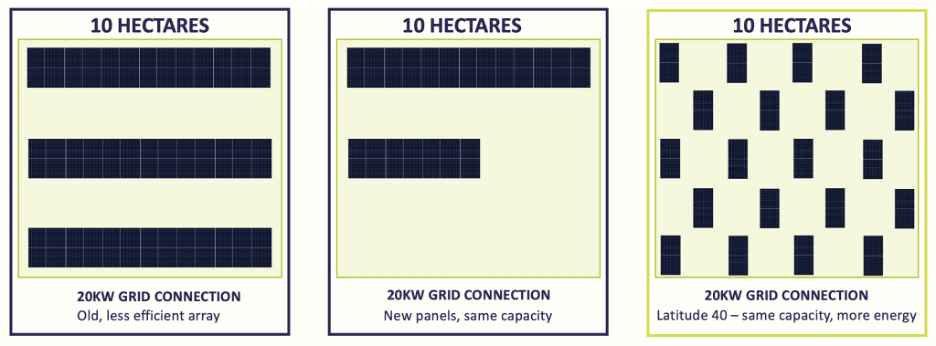
Modernising solar farms with more efficient panels and flexible array designs could allow landowners to maintain agricultural production while also creating opportunities for on-site electricity use, agricultural electrification, environmental benefits and battery storage. Revamping offers an opportunity to improve the utilisation of solar assets without necessarily increasing maximum export capacity. To understand why, it’s important to understand how site layouts vary.
Figure 3 shows the different array layouts. The tracker array will use the whole area of the site but improve landowner outcomes.
Extending existing solar farms may require renegotiating land agreements, creating an opportunity to offer landowners more than rental income alone. Combining solar generation with continued agricultural use and improved biodiversity could make lease extensions more attractive to both parties.
In England, developments subject to mandatory Biodiversity Net Gain (BNG) must deliver at least a 10% improvement in biodiversity value. Where a site delivers gains beyond its planning requirements, surplus biodiversity units may be sold to other developers, creating a potential additional revenue stream.
Corrie’s Latitude40 trackers offer a different approach to land use. Their elevated design and moving shadows reduce persistent shading, potentially supporting healthier vegetation, grazing and habitat management. Subject to ecological assessment, this could help repowered sites improve biodiversity outcomes and, where eligible, generate saleable biodiversity units.
Repowering therefore offers an opportunity to improve returns through three complementary benefits: higher-value electricity generation, continued agricultural use and the potential to monetise biodiversity gains.
LOOKING FORWARD
Stafford’s analysis highlights an important shift in European renewable investment: site upgrades increasingly present a strong investment opportunity. Existing sites have valuable advantages, but their original designs reflect the technology, economics and priorities of an earlier period. Tracking offers a way to improve the overall site outcome, giving different options for installed capacity, energy yield, grid utilisation, land use, ecology and electricity value.
For Corrie Energy, this is where dual-axis tracking and site-specific array optimisation become particularly relevant. Our Latitude40 technology and Sol3D modelling tools allow alternative layouts and generation profiles to be evaluated against the constraints of each site. As we move into a new era of solar redevelopment, technology changes offer the chance to deliver much more value from the same site.